

By: Sheila Cain
A guide to the different types of nursing degrees
From certificate programs to doctoral degrees, there are many different pathways to a career in nursing.

With so many types of nursing degrees available, it’s important to understand how each program works so you can find the one that’s right for you. Whether you’re a recent high school graduate, experienced professional, or career changer, making the right decision means considering each option against your goals, financial resources, and lifestyle.
The degree you pursue determines which level of nursing you’ll eventually enter, at least to begin with. By selecting the program that meets your personal and professional goals, you’ll position yourself for success in the rewarding field of nursing.
We’ve compiled a descriptive list of the different types of nursing degrees available and what they involve in regard to program content, length of time, and job potential.
Nurse degree pathways
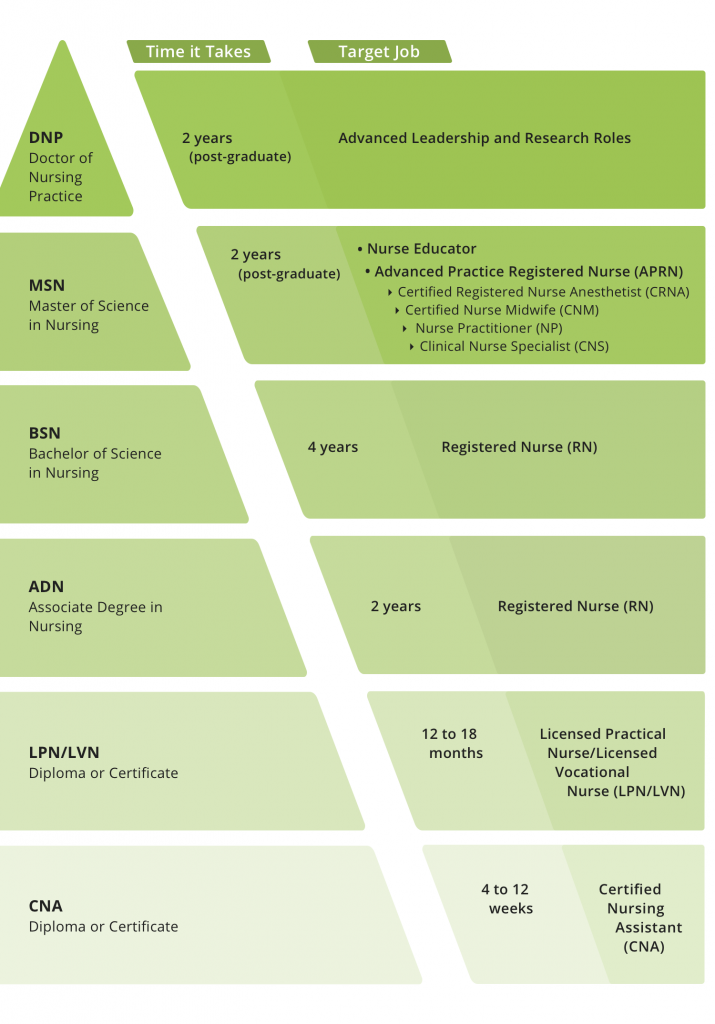
How long each level of nursing takes and what you can do with your degree
CNA certificate or diploma
A certified nursing assistant (CNA) certificate is a non-degree diploma offered at community colleges and vocational schools. Both classroom and online options are available, though all clinical hours must be performed in person at an approved location.
As a CNA student, you’ll learn how to provide basic healthcare services and help patients with their daily activities. Other duties typically include:
The curriculum includes training in emergency procedures, personal care skills, and infection control. To increase your employment options, you can also earn voluntary certification in specialized areas such as psychiatry or geriatrics.
Who a CNA is best suited for
CNA certificates are designed to get students into the nursing field as quickly as possible. Prerequisites vary by program, but most include a high school diploma or GED.
A CNA certificate might be right for you if you fall into one of the following groups:
Length of time to complete a CNA
A CNA certificate is the fastest way to qualify for an entry-level nursing position.
While the exact education requirements vary by state, federal guidelines for CNA certificate programs require at least 75 hours of education, with a minimum of 16 hours of supervised clinical training.
Most CNA programs can be completed in just four to twelve weeks.
What you can do with this certificate
After earning a state-approved certificate, you’ll be qualified to take your state’s CNA competency exam. With certification, you can apply for jobs in which you’ll work with patients under the direction of a licensed practical nurse or registered nurse, depending on the laws of your state.
Most nursing assistants—roughly 37%— work in nursing care facilities such as skilled nursing facilities, according to the U.S. Bureau of Labor Statistics (BLS). Other employers include:
What you can earn
Per
LPN/LVN certificate or diploma
A licensed practical nurse (LPN) certificate is a non-degree diploma offered at vocational schools, community colleges, and sometimes at hospitals themselves. In Texas and California, this role is known as a licensed vocational nurse (LVN).
Both LPN and LVN programs prepare you to work under the supervision of RNs and perform the following key duties:
In addition to clinical applications, you’ll also learn about general medical topics that include anatomy, physiology, nutrition, and emergency care. Specialty certifications in areas such as IV therapy, long-term care, pharmacology, and breastfeeding support are also available.
Who an LPV/LCN is best suited for
An LPN/LVN certificate is for students who want to enter the nursing field without the time and cost of earning a college degree. In contrast to a CNA diploma, the LPN certificate represents mastery of a more comprehensive body of knowledge. In many states, LPNs and LVNs qualify to supervise CNAs.
An LPN/LVN certificate could be right for you if you’re in one of the following groups:
Many LPNs eventually go on to earn advanced degrees. Because of this, it’s important to earn an LPN/LVN certificate from an accredited nursing program. In many cases, credits earned in a nonaccredited program won’t be eligible for transfer to a higher degree.
Length of time to complete an LPN/LVN
Most LPN/LVN certificates can be completed in about 12 months, though your timing may vary. State-approved programs provide the number of clinical hours necessary to meet the certification requirements of your state. Depending on your criteria, programs can range between seven and 24 months.
What you can do with this certificate
With an LPN/LVN certificate, you’ll be qualified to take the National Council of State Boards of Nursing’s National Council Licensure Examination, or NCLEX, for LPNs. Passing this exam and meeting your state-specific requirements will make you eligible for licensing.
With your certificate in hand, you can go on to find jobs in several different places. According to the BLS, most LPNs and LVNs work in nursing and residential care facilities. Other common employment options include administrative and clinical positions in locations such as:
What you can earn
According to the BLS, LPNs and LVNs earn a median annual wage of $62,340.
Associate Degree in Nursing
An Associate Degree in Nursing (ADN) is the minimum degree requirement for becoming a registered nurse (RN), the most common nursing profession. As an RN, you’ll have the credentials necessary to qualify for most nursing jobs that involve providing critical patient care and assisting physicians.
You’ll find ADN programs at community colleges and some four-year institutions. Some schools also offer online nursing degrees in hybrid programs that combine virtual instruction with on-site clinical training.
ADN programs will give you the knowledge and experience RNs need to perform the following duties:
The curriculum for an ADN also includes studying science-related courses such as anatomy, biology, chemistry, and physiology.
Who an ADN is best suited for
An ADN from an accredited nursing school is a good choice if you want to become an RN without the commitment of a four-year degree. It’s important to note, however, that while this is the minimum education for licensing, employers are increasingly making a Bachelor of Science in Nursing (BSN) degrees a requirement for new hires. In some states, RNs with associate degrees will eventually need to earn a bachelor’s in order to maintain their license. The good news is that most bachelor’s programs will allow you to transfer some basic credits earned from your accredited ADN.
An ADN might be the right choice if you’re in one of the following groups:
Length of time
ADNs typically require around two years to complete. State-approved programs will include extensive on-site clinical training that aligns with your state’s requirements for licensing.
What you can do with this degree
Earning an Associate Degree in Nursing will make you eligible to take the NCLEX-RN, a prerequisite for RN licensure in all U.S. states. With RNs in high demand, nurses can often secure jobs that offer tuition reimbursement to continue their nursing education at reduced personal expense.
After earning their license, the BLS says more than half of all RNs go on to work in hospitals, but you can use your credential in many types of environments. Consider pursuing a career in:
What you can earn
Salaries for nurses vary widely depending on their education, level of experience, setting in which they work, and any specialty they may have. That said, the BLS reports the median annual salary for RNs to be $93,600. Those working in high-level roles within the pharmaceutical industry could earn significantly more.
Bachelor of Science in Nursing Degree (BSN)
A nursing degree, such as a Bachelor of Science in Nursing (BSN), is typically earned through four years of study. This degree equips graduates to work in various healthcare settings, including community and public health, acute and critical care, long-term care, and outpatient facilities. BSN programs offer different types of curricula to meet individuals’ career goals and aspirations.
With a combination of academic classwork and on-site clinical training, you’ll learn about scientific areas such as anatomy, biology, and chemistry, as well as specific duties related to patient care, laboratory testing, designing treatment plans, and assisting with surgery.
Some schools even offer programs that allow you to earn a BSN in a particular specialty of nursing such as acute care, geriatric nursing, infectious disease, pediatrics, and psychiatry, just to name a few. Specializing can often increase your job opportunities and potential earnings.
Who a BSN is best suited for
A Bachelor of Science in Nursing (BSN) is a four-year degree designed for RNs who want to pursue supervisory roles and qualify for higher-paying nursing jobs.
If you’re ready to work as an RN, a BSN could be right for you if you have the time and financial resources to commit to four years. A BSN is also an ideal starting place if your ultimate goal is to earn a master’s degree and work as an advanced practice nurse.
However, as the demand for nurses with BSNs grows, more schools cater to students interested in categories beyond those listed above. Depending on your situation, you can find a traditional program or one designed to apply education you’ve already earned.
Ways to earn your BSN
There are many different paths for you to follow as you seek your BSN—from traditional programs you can enter into right out of high school, to programs that fast-track your degree using the knowledge you may already have.
Traditional BSN
Traditional BSN degree programs are intended for recent high school graduates who have little to no professional healthcare experience. Requirements are similar to other bachelor’s degree programs, though specific science prerequisites may be necessary.
LPN-to-BSN
LPN-to-BSN degree programs, often called “bridge programs,” allow LPNs/LVNs to get degree credit for their previous education and experience. For these students, earning a BSN usually requires taking liberal arts coursework not offered in LPN/LVN programs.
RN-to-BSN
RN-to-BSN degree programs—sometimes called ADN-to-BSN programs—are designed for RNs who already have an associate’s degree. Graduates of accredited ADN programs often transfer educational credits to meet some of the BSN course requirements, meaning they can earn their bachelor’s in less time.
Second degree BSN
Second-degree BSNs are meant for career changers with a bachelor’s degree in a non-nursing field. These programs allow students to satisfy some of the BSN’s liberal arts requirements by transferring credits from their first degree, again shortening the length of time.
Length of time
Traditional BSN programs require four years of full-time study. Students who have LPN or RN licensing, or a bachelor’s degree in a different field, might qualify for alternative BSN programs that could be completed in one to two years.
Since so many working RNs pursue BSNs for career advancement, there are many flexible part-time and online options, though they may add to your time to completion.
What you can do with this degree
If you don’t already have your RN license from a previous associate degree, earning a BSN will qualify you to sit for the required NCLEX-RN licensing exam. With job growth for RNs predicted to grow by 4.9% through 2034, you’re likely to find a wide range of job opportunities with this degree.
More than half of RNs work in hospitals, though with your additional clinical experience and specialized skills, you can find a variety of less traditional roles. These could include:
What you can earn
As with RNs with associate’s degree, salaries vary based on a number of different factors. While the median for all RNs is $93,600, those in the top 10% earn more than $135,320 per year. With a BSN, you can often expect to make more than with an associate degree.
Master of Science in Nursing (MSN)
A Master of Science in Nursing (MSN) is a graduate program of study designed for nurses who want to practice in a specialized role known as an advanced practice registered nurse (APRN).
The curriculum is an MSN program that’s far more tailored than a general nursing degree. You’ll dive deep into a concentrated area of study while taking advanced courses in topics such as leadership, management, healthcare policy, and research.
Who it’s for
Requirements vary by program, but MSNs are typically designed for licensed RNs who have already completed a bachelor’s-level education.
You might qualify for an MSN program if you’re in one of the following groups:
Ways to earn your MSN
There are other pathways to a master’s degree, including:
RN-to-MSN
Some MSN programs offer admission to RNs with associate degrees, allowing them to achieve an MSN without having to spend four years earning a separate BSN (which is the traditional prerequisite for an MSN.) An RN-to-MSN bridge program still teaches the material you would have learned if you received a BSN. They are fast-paced and intense and designed for students who want to complete their degree quickly.
BSN-to-MSN
A BSN-to-MSN program is essentially the same as a traditional MSN program since a BSN is a prerequisite. These bridge programs are often marketed as “fast-track” programs, and will often include MSN generalist programs or programs in non-clinical specializations, like nursing education or nursing administration, which typically require fewer clinical hours for completion.
Length of time
Students who begin MSN programs with a BSN typically take about two years to complete their degree. If you’re pursuing an MSN without BSN credentials or with a bachelor’s in another field, you can expect roughly three years.
What you can do with this degree
With an MSN, you’ll be prepared to work as an APRN in your area of concentration. To do so, you’ll need to hold a state license as an RN and a national credential in your specialty. Specializations vary by program, but common options include the following:
Nurse practitioner
A nurse practitioner’s (NP) duties are similar to those of physicians. While some states require NPs to work under a physician’s supervision, NPs have more responsibility for diagnosing and treating patients than traditional RNs. Some industry associations have considered making a DNP the entry-level degree for nurse practitioners by 2025, although this is not yet required.
Clinical nurse specialist
Working as a clinical nurse specialist (CNS) involves applying advanced training and education to a specific patient group or type of treatment. The specialty area of a CNS can be defined by a specific population, disease, type of care, or treatment setting. There’s buzz within the industry that by 2030 a DNP may be the entry-level degree required for CNSs, but that has not been formally decided.
Certified nurse midwife
The role of a certified nurse midwife (CNM) includes working with mothers during pregnancy, birth, and postpartum phases. CNMs are considered primary providers in all 50 states.
Certified nurse anesthetist
A certified nurse anesthetist (CNA) works closely with physicians to safely administer anesthesia prior to procedures, monitor the patient during surgery, oversee the recovery, and develop plans for pain management. By 2025, a doctoral degree will be required to become a nurse anesthetist.
Nursing informaticist
Nurse informaticists combine patient care with technical experience. In this profession, you’ll use data to make healthcare decisions and reinforce healthcare services. If you have a knack for data sciences and want to make a difference in healthcare, this profession may be for you.
What you can earn
The salaries of APRNs vary depending on the exact job title, where they work, and level of responsibility. As of 2022, the BLS offers these general guidelines for median salaries:
Based on U.S. Bureau of Labor Statistics (BLS) data (2022), not school-specific information. Conditions in your area may vary.
Joint master’s degrees in nursing
Earning a joint master’s degree in nursing could be right for you if you want to earn an MSN and a complementary degree in less time than completing two separate programs. You’ll get a solid education in nursing practice and theory while gaining advanced skills in another area that can help you tailor your career.
Who they’re for
Joint master’s degrees are designed for nurses who want to guide their careers toward specific types of leadership positions. Keep in mind that in order to pursue a joint degree you have to gain admission into each separate program. These degrees are meant for very serious students only, as you’ll need to work on two demanding course loads at the same time.
Length of time
It typically takes between 18 months and three years of full-time study to complete a joint master’s degree in nursing. While part-time and online options are available to accommodate working schedules, they’ll likely extend your time to completion.
What you can do with these degrees
Any joint degree will expand your opportunities for advancement and higher earnings. Specific roles will depend on the type of degrees you earn, but there are three common combinations.
Joint MSN/MPH
Pairing an MSN with a Master of Public Health (MPH) is designed for nurses who want to pursue leadership positions in community or public health organizations.
Joint MSN/MBA
Combining an MSN with a Master of Business Administration (MBA) is sometimes known as being in the “Nurse Executive Program.” Here, students learn the business skills necessary to hold executive-level roles in hospitals and other large healthcare organizations.
Joint MSN/MHA
Earning an MSN with a Master of Health Administration (MHA) offers similar benefits to the joint degrees listed above, but the combination is a bit broader. You’ll be educated about making important decisions related to the management of various healthcare organizations and educational settings.
What you can earn
The BLS doesn’t report data for jobs explicitly requiring joint degrees, however, roles that fall under the general umbrella of medical and health services managers earn an average annual wage of $117,960.
Doctoral degrees in nursing
Doctoral degrees in nursing are terminal degrees intended to help students gain the knowledge necessary to teach at the university level, conduct research in the field, or pursue high-level roles similar to those for students with joint master’s degrees.
Who they’re for
In some programs, these degrees are only for those who have their master’s. In others, BSN graduates may qualify for programs that allow them to earn an MSN and doctoral degree simultaneously. No matter what type of program you choose, you’ll need to enter with a degree specifically in nursing and clinical experience under your belt.
Length of time
On average, a doctoral degree in nursing takes two years to complete, though your timeline depends on the type of degree you seek.
What you can do with this degree
Your career opportunities will vary, but there are three primary options based on your degree.
Doctor of Nursing Practice (DNP)
A DNP is a practice-oriented degree that emphasizes clinical leadership and advanced theory. It can help you qualify for higher-paying executive positions in hospitals and other healthcare organizations.
Doctor of Nursing Philosophy (PhD)
A nursing PhD focuses on scientific content and the creation of new research in the field. PhD programs typically include the completion of a dissertation and research papers. This degree can help you qualify for leadership positions in research and academia.
Doctor of Nursing Science (DNSc or DNS)
The Doctor of Nursing Science (DNSc or DNS) is a research-based doctoral degree. Like a PhD, it prepares graduates for roles as nurse educators and researchers.
What you can earn
As with those with a joint master’s degree, it’s hard to say precisely what you might earn with a doctorate in nursing. Salaries can vary by tens of thousands of dollars depending on your position, your employer, your location, and more.