


The growing demand for home health nurses: What you should know

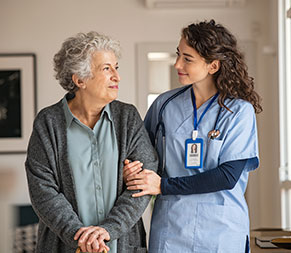
As unusual as it may seem by today’s standards, treating sick and injured patients in their own homes was once the standard for healthcare delivery. Hospitals were often treated as a last resort for the critically ill or those who didn’t have family, friends or neighbors that could help them at home. Home healthcare is much more common in other countries around the world, but it’s a different story in the United States where only a fraction of today’s registered nurses work in home health.
However, some current data indicates this could change. As we rediscover the benefits of home healthcare—practicality, personalization and potential cost-effectiveness for both provider and patient—the demand for home health nurses should follow suit.
What sets home health nursing apart?
Home health nursing is nursing care that takes place in the patient’s home. It can take many forms and offers a unique care experience for nurses that can be completely different from other, more traditional healthcare settings.
“It can be home visits from a home health agency after someone returns home from the hospital to recover from surgery or illness. It can be a hospital-based program where they’ll do maybe a one-time visit to people who they worry about. It could be home dialysis from a dialysis center. Public health [agencies] and hospitals will sometimes do maternal child visits, and then hospices provide hospice care, so there’s quite a bit of variety,” said Dr. Susan Hinck, PhD, a gerontological clinical nurse specialist and President of the International Home Care Nurses Organization (IHCNO).
Home health nurses are typically assigned to patients which they visit on a regular basis for continuity of care. In doing so, they often get to form closer relationships with their patients because they see them over a longer period of time.
“I like the long-term relationships where you work with someone and see what’s important to them, and you get to see how they’re getting along with the interventions. What works, what doesn’t work,” Hinck said. “It’s working with people in a way that’s more holistic, more complete, because they’re in their own setting. You can see how they’re doing in their setting, and all those other things that you need to look at to make sure someone is safe and getting healthy.”
It’s working with people in a way that’s more holistic, more complete, because they’re in their own setting. You can see how they’re doing in their setting, and all those other things that you need to look at to make sure someone is safe and getting healthy.
Another big difference that distinguishes home health nursing is the level of autonomy home health nurses have.
“Some of the things that are different about home-based care is the nurse has greater autonomy because they’re alone in the home,” Hinck said. “There’s no next shift coming on. If you don’t see it, nobody’s going to see it. If you don’t assess it, it’s not going to get assessed—so you really have to be very skilled in doing a comprehensive patient assessment, and not just looking at the patient but their environment. Whether they have food, if they can prepare the food right, do they have transportation to a medical appointment, do they have the correct medication in the home and know how to take it. It’s a lot of things to think about.”
Home health nurses also must loop patients into their plan of care much more than if they were caring for them in, say, a hospital. “This is an especially important thing in home care: include the patient,” Hinck said. “In the home, the patient has the ultimate authority over their own actions, what they’re going to do, what they’re not going to do. So if it isn’t the patient’s plan of care, it’s just not going to go anywhere.”
Why home health nursing is on the rise
Many recent reports and statistics point to a growing demand for home healthcare services and the staff to provide them. A 2023 report specifically looked at home and community-based services (HCBS) funded by Medicaid, the primary payer for long-term services and supports. Between 2013 and 2020, the number of Medicaid HCBS participants grew more rapidly than the workforce providing those services. As a result, the number of home care workers per 100 HCBS participants declined by 11.6% between 2013 and 2019. Early estimates indicate that this trend has only continued through 2020 and beyond. This shortage suggests an expansion of job opportunities for home health nurses.
“There is a growing demand I think,” Hinck said. “In the United States, about 12% of registered nurses work in home healthcare, and that’s a pretty small percentage, but that’s also an underestimate because it’s nurses that only do home health and it doesn’t look at all the other ways nurses go into homes.”
One primary reason for this workforce shortage is our aging population. According to a 2023 report from the Administration for Community Living, a division of the U.S. Department of Health and Human Services, the 85 and older population is projected to more than double from 6.5 million in 2022 to 13.7 million in 2040. Since home health services often cater to the needs of older adults and the elderly, this could precipitate a growing demand for home health nurses as time goes on.
Data from the U.S. Bureau of Labor Statistics (BLS) also supports this. The BLS estimates that the employment of home health and personal care aides will grow $35,800 through 2035, faster than the average across all occupations. Even though registered nurses are a separate employment category that includes nurses from all specialties, this statistic still demonstrates a growing need for home healthcare professionals of many kinds.
Why you should consider working as a home health nurse
In addition to strong job growth projections, home health nursing may be an appealing niche for numerous other reasons:
Develop closer relationships with patients:
By treating the same patients over a longer period of time, you may get the chance to form closer bonds with your patients compared to the in-and-out nature of other healthcare settings. “It is a way to blossom as a nurse because you are one-on-one. You can give that patient all of your attention, and that’s very gratifying,” Hinck said.
Flexible scheduling:
Hinck also pointed out that home health nurses tend to have a more flexible schedule. During holidays, for example, patients may not want to be visited if they are enjoying time with their families, so you may not have to work those days either.
Opportunity to work with and learn from other healthcare providers:
Another difference in home-based care, Hinck said, is that you end up working more closely with other disciplines such as occupational or physical therapists. In hospital settings these disciplines operate somewhat separately, but in home-based care, you have to confer with these other professionals more so that you’re all on the same page about what the other providers have done and how the patient is progressing.
More daily autonomy:
When you’re out visiting patients, you’re often on your own. Though they still have a clinical supervisor to report to, home health nurses typically have more decision-making authority than nurses in other settings.
How the pandemic affected home health nursing
While examining the state of home health nursing today, it would be negligent not to consider the impact of the COVID-19 pandemic as well.
“COVID impacted absolutely everything in healthcare, in all settings. What we saw at the time was many patients who needed help at home declined home visits for illness or after hospitalization because they were afraid to have somebody come into their home and bring an illness in. But on the other hand, that’s when the Hospital-at-Home program started,” Hinck said.
Indeed, the pandemic caused an all-around healthcare staffing shortage that the industry is still recovering from today. It also forced home health nurses to make changes to the way they do their jobs.
“It also brought infection prevention to the forefront as a primary concern. You were going into a home where you didn’t know how sick those people were, or if the patient is worried about you coming into the home as a healthcare provider, so we really had to pay attention to making sure we had the right protective equipment, how to use it and all those infection prevention measures. And then virtual visits became much more frequent and more important as well,” Hinck said.
Preparing for a career in home health nursing
Given the demand for home health nurses everywhere, transitioning into the field isn’t necessarily an overly complicated process. Though some employers may prefer nurses that have some years of experience already under their belt, Hinck said many others hire new nursing graduates, too.
“Some schools of nursing, though not very many, will have home visits as part of their student experience. Whenever that happens, the students who get to do it often really enjoy it,” Hinck said. “You can look at the employers in your area, whether it’s the hospital-based home visits or home health agencies or hospices.”
Hinck also said nurses might want to consider checking out the Medicare Care Compare website and checking out the healthcare providers in their area to investigate their quality indicators and see if it might be somewhere they want to work.
No matter whether you’re just starting out or already in the field, Hinck said that a huge part of being a successful home health nurse is your ability to honestly assess your own skills to ensure you have what you need to have a successful visit. “If you’re going to do a procedure you haven’t done in a while, you either need to go through the steps of it or watch a video or do the procedure on a mannequin at your home office so that when you go into the home, you are confident.”
If you have the self-starting accountability to continuously improve your skills, you could thrive in a home health setting.
Parting thoughts
Recent reports from a variety of sources point to a growing demand for home health nurses nationwide. Nursing students and established nurses alike should consider the many benefits of home health nursing—including more flexible scheduling, greater autonomy and the ability to develop closer bonds with patients—and see if this unique specialty could be a great fit for them and their career.