


Why public health nursing is gaining importance in a post-pandemic world

Are you thinking about a career in public health nursing?
Public health nurses (PHNs) bridge the gap between clinical care and community well-being. And the practice area has gone through real transformation in the wake of COVID-19.
Flexible work arrangements. Virtual meetings. Multidisciplinary collaboration and cutting-edge technologies. Nuanced programs that address current issues like vaccine hesitancy. For PHNs, these are just the beginning. Let’s talk about how public health nursing has become more important in our post-pandemic world.
What is public health nursing?
Public health nursing focuses on improving the health of entire communities. The practice area applies knowledge from nursing, social sciences and public health disciplines to improve care delivery. It also allocates resources and guides the development of health policies and research.
The overarching goal is to address systemic health issues such as diabetes and obesity, while also helping to reduce the spread of infectious diseases like influenza and respiratory syncytial virus (RSV).
Unlike clinical nurses who typically provide one-on-one care, PHNs work on broader initiatives that impact population health. For example, they may lead immunization drives that target under-vaccinated populations, design education campaigns for underserved communities or advocate for public health policies that address food insecurity.
“There is so much to public health nursing and so many areas to move into,” said Kelly Lind, RN, Public Health Nurse Supervisor in St. Louis County, Minnesota. “You can work in programmatic areas that are meeting clients’ needs at an individual level. But there’s also community and systems-level work that you can grow into that makes a bigger, broad-spectrum impact.”
What do public health nurses do?
PHNs don’t just focus on big-picture community health. They’re also very hands-on, with responsibilities such as:
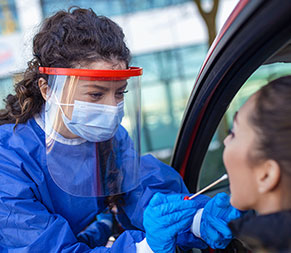
For example, during the COVID-19 pandemic, PHNs in rural Alabama led mobile vaccination units to reach isolated communities. These nurses administered vaccines and provided education about their safety. During a severe public health crisis, these nurses addressed vaccine hesitancy on a truly personal level.
Nicole Spitzer, RN, BSN, Public Health Nursing Senior Manager in Anoka County, Minnesota, shared another creative solution to vaccine hesitancy. Using the Minnesota Immunization Information Connection (MIIC) system, her team launched a targeted texting campaign to reach families of children overdue for their measles, mumps and rubella (MMR) vaccinations. The initiative set out to address the largest increase in measles cases since 2017. And the result? A 20% increase in vaccine completions, according to Spitzer.
“This was very insightful information,” Spitzer said. “It made us wonder: is it solely vaccine hesitancy that is lowering rates, or was it access to healthcare during the pandemic and the culture shift to virtual medical visits?”
Where do public health nurses work?
PHNs work where they’re needed most. Often they partner with local, state and federal agencies to advocate for better healthcare resources. The idea is to make sure community members have what they need to stay healthy and informed.
Yet public health nurses are employed by a range of organizations that serve the community, including:
Today, PHNs frequently work as part of multidisciplinary teams that include public health educators, community health workers and epidemiologists. The aim is for teams to address complex health challenges from multiple angles.
“In the past, in my public health department, we had mainly nurses,” Lind said. “But after the pandemic, with the nursing shortage, we realized we needed to diversify our workforce.”
The nuanced, collaborative nature of public health makes nurses feel more supported.
“Our nurses are very autonomous,” Lind said. “We come into the office to get our things, and we’re out and about. You start work from home, and you end work at home.”
For the nurses in Lind’s unit, three days out of a five-day work period are mobile work days. This means PHNs can stay active and engaged in their communities.
Public health nursing and the COVID-19 pandemic
When Lind started her public health nursing career in 1998, work schedules were rigid, and PHNs worked fixed hours in office or clinical settings. Days were highly structured, and PHNs didn’t have much say over their schedules.
But during the pandemic, public health employers realized something: if they wanted to take care of their communities, they needed to take care of their staff. The demands of COVID-19 highlighted the need to support PHNs.
Now expectations have shifted. Post-pandemic, PHNs enjoy a certain level of flexibility, which makes the profession more attractive to nurses seeking autonomy.
“COVID-19 really pushed us to embrace flexible, outcome-based expectations,” Lind said. “Now we trust our staff to make their own hours, adjust their schedules and get their work done.”
Spitzer has seen technology change public health nursing for the better, too.
“When I started in 2012, we were still documenting in paper records,” she said. But during the pandemic, her team transitioned to fully virtual operations and introduced telehealth visits, electronic document signing and online resource repositories for staff.
“It was really a great time for innovation,” Spitzer added. “These efficiencies allowed PHNs to serve populations who might have otherwise been left behind.”
The pandemic also accelerated the adoption of new technologies like wearables, which help patients track metrics like heart rate, blood pressure and lung function. And PHNs are increasingly finding that this focus on technology and flexibility has made public health initiatives more impactful. It also benefits individual nurses, as studies show that nurses with better work-life balance stay in the field longer.
“We want our staff to have physical and mental wellness when they come to work, and we know having a healthy work-life balance is one of those keys,” Lind said.
The future of public health nursing: What comes next?
As public health systems evolve, PHNs will play an even more important role in addressing complex health challenges.
They will continue to shape community health outcomes, making full use of key trends such as:
- Working across disciplines: Multidisciplinary collaboration is becoming an important part of public health efforts. In Stark County, Ohio, PHNs worked alongside police officers to address rising opioid overdoses.
- Making the most of technology: Tools like mobile clinics and data analytics are transforming how PHNs operate. For instance, public health leaders in Texas now use Geographic Information System (GIS) mapping to track community health resources and outcomes.
- Putting equity first: Overcoming health disparities is one of PHNs’ highest priorities. “Public health nursing is an absolute need and value in the system,” Lind said.
- Building stronger systems: With more funding for nurses after COVID-19, opportunities for leadership and specialized roles have grown. This drives long-term improvements in community health.
In addition, Spitzer sees an opportunity to improve how scientific findings are shared with the public.
“I anticipate we will need to shift to getting the science disseminated to the public by use of communication and marketing experts in place of doctors and subject matter experts,” she said. “This is a lesson learned during the pandemic and something many local public health departments are actively working on.”
Career trajectory for public health nurses
Public health nursing can bring great personal fulfillment and plenty of room for professional advancement. According to the U.S. Bureau of Labor Statistics (BLS), the median annual salary for registered nurses is $97,550, while those working in government earned more.
Advanced degrees, certifications or experience in areas like epidemiology or health informatics can increase earning potential even more and lead to opportunities in leadership positions. Many nurses find that public health systems give them a chance to pursue ongoing education at no cost to them. This helps PHNs further their expertise and take on more complex responsibilities as they progress in their career.
With the focus on community health and public health infrastructure, the employment of PHNs is expected to grow by 5.6% through 2035. This growth is proof that PHNs are essential in our communities.
Wrapping it up
Public health nursing has a clear, tangible impact on building healthier communities. By addressing individual needs and targeting systemic issues, PHNs make a difference in the very places they work and live.
“Public health nursing offers opportunities you have a hard time getting in a clinical or hospital setting,” Lind said. “If you want to hone in on what public health nursing practice is and best utilize your skills, this is the field for you.”
Post-pandemic public health nursing has become all the more critical in our communities. For nurses seeking a career with meaning, this practice area is a major draw. And all you need to do is become licensed as a registered nurse (RN) to get started.