

Since 1969, the American Nephrology Nurses Association (ANNA) has been the professional association representing nurses who work in all areas of nephrology. With chapters all across the U.S., ANNA’s mission is to improve members’ lives through education, advocacy, networking and science. They also publish the “Nephrology Nursing Journal.”
Explore Related Nurse Specialties
Learn to become a dialysis nurse
Dialysis nurse career overview
Where you’ll work: Hospitals, dialysis clinics, kidney care centers, home care settings, long-term care facilities, outpatient clinics and more.
What you’ll do: Administer dialysis treatments to patients and treat a variety of kidney issues including kidney disease and kidney failure.
Minimum degree required: ADN or BSN required for licensure. A BSN or higher is required for the Certified Nephrology Nurse (CNN) credential.
Who it’s a good fit for: Nurses that want the flexibility to work in a variety of settings.
Job perks: Dialysis nurses may have more travel opportunities as it’s possible to administer dialysis treatments from patients’ homes depending on their needs.
Opportunities if you pursue a higher degree or certification: RNs can pursue certification as either a Certified Dialysis Nurse (CDN) or Certified Nephrology Nurse (CNN) through the Nephrology Nursing Certification Commission (NNCC), which could lead to better jobs with higher salaries.
Median annual salary: $93,600
What is dialysis nursing?
Dialysis nursing is a part of the specialization known as nephrology nursing, the branch of nursing that treats patients in need of kidney care. Dialysis nurses administer dialysis treatments to patients experiencing chronic kidney disease (CKD) and other kidney problems.
Dialysis nurses are considered nephrology nurses, but not all nephrology nurses work specifically as dialysis nurses.
In this Article
Dialysis Explained | What Dialysis Nurses Do | Requirements | Certifications | What to Expect | Salary and job outlook | Resources
Dialysis explained
Though they may fly under the radar compared to high-profile organs like the heart, lungs or liver, our kidneys are just as important for our everyday health. Kidneys remove waste and excess fluid from our bodies, filter our blood to maintain safe mineral levels and help regulate blood pressure. We cannot survive without these vital functions.
When our kidneys don’t work how they’re supposed to—due to CKD or acute kidney injury, for example—that’s where dialysis comes in. It’s a treatment that removes waste and extra fluid from the blood. There are two types: hemodialysis (HD) and peritoneal dialysis (PD). In hemodialysis, a filtering machine called a dialyzer removes waste and fluid from the blood and then returns the filtered blood back to your body. With peritoneal dialysis, a catheter is placed inside the patient’s belly which is periodically filled with a cleansing fluid called dialysate.
Since dialysis does not replace all the functions performed by our kidneys—only waste and fluid removal—it’s not considered a cure for kidney disease or failure. Many dialysis patients are placed on a kidney transplant list with the hope that a new kidney can eliminate the need for indefinite dialysis treatments.
“A transplant would be the only way that you could get off dialysis,” said Katherine Houle, a nephrology nurse practitioner and the Executive Director of the Nephrology Nursing Certification Commission. “There are a lot of diseases that affect just the kidney, so for patients that are otherwise healthy, if they got a transplant they would likely do fairly well.”
The problem, Houle said, is that the wait list for receiving a kidney can be very long—five to seven years in some cases. Getting a kidney transplant, therefore, doesn’t always make sense for everyone. These patients may choose to instead stay on dialysis forever or end treatment and transition to palliative or hospice care. “The wait list is really the limiting factor of a transplant, and of course that’s due to the lack of donors.”
Patients who have found a willing donor would of course be able to get a transplant much sooner, provided they are a suitable match. A kidney match is determined by blood type compatibility and a few other biological factors.
What do dialysis nurses do?
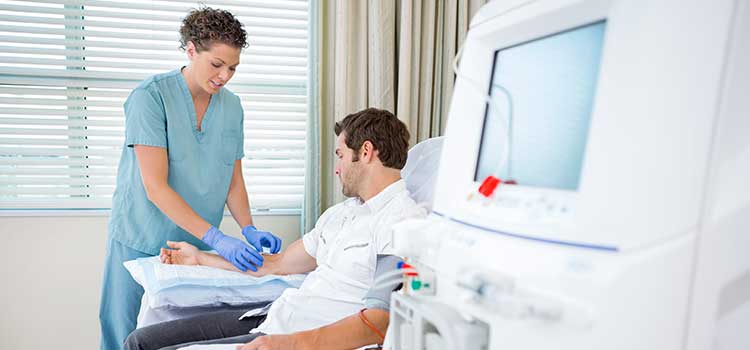
Dialysis nurses perform a range of functions depending on their specific role and where they work. As with all nurses, they take and record patient vital signs, administer treatments, assist doctors with certain procedures, educate patients and more. Their primary duty is administering dialysis treatments to patients.
“Dialysis nurses work in dialysis units where they see patients three times a week,” Houle said. “They connect them to the dialysis machines, monitor the treatment, go through their medications so that the patient understands how, when and what medications to take, and they go through their lab work so the patient understands what the results mean.”
Dialysis treatments can take place in hospitals, dialysis clinics, kidney centers or even in patients’ homes.
Nurses working in the larger umbrella of nephrology—of which dialysis is a part—may also treat patients with other kidney-related problems including kidney stones, hypertension, diabetes, kidney transplants, polycystic kidney disease and more. According to Houle, nephrology nurses are also involved in a lot of patient education.
“CKD is divided into five stages. Typically by the time you get to the fifth stage in progression you’re looking at—if not already on—dialysis. When the patient is around stage three, those nephrology nurses working in the office can do what’s called CKD training, which allows the patient to become more aware of what the options are: different types of dialysis, transplant, different ways to slow progression of the disease, that kind of thing. So we have a lot of nephrology nurses that are involved in patient education,” Houle said. “I’m a nephrology nurse practitioner so I see patients that are in all stages of kidney failure, from the very first diagnosis to people that are on dialysis, to people that get transplants and then post-transplant—the full range of patients in the office.”
Where they work
Dialysis and nephrology nurses work in a wide variety of healthcare settings.
“Nephrology nurses practice in dialysis clinics, hospitals, home settings, long-term care facilities, transitional care units, healthcare provider practices, transplant programs, and many other inpatient and outpatient settings. They work in primary, secondary, and tertiary care facilities—wherever individuals experiencing or at risk for kidney disease receive healthcare,” says the American Nephrology Nurses Association.
Requirements to work as a dialysis nurse
Hopeful dialysis nurses must become registered nurses (RNs) first. This begins with earning either an Associate Degree in Nursing (ADN) or a Bachelor of Science in Nursing (BSN) degree. Both types of programs are acceptable paths to licensure and have their own pros and cons. Some employers may prefer or require nurses to have a BSN, for example, which is something to consider. If you earn an ADN initially, you can always finish a BSN later.
After completing your education, you must take and pass the National Council Licensure Examination for Registered Nurses (NCLEX-RN) and apply for licensure in the state that you live and work. Each state has their own licensing process, so be sure to check with your state’s licensing board to ensure you complete everything required for licensure.
Getting experience
After getting licensed, it’s all about gaining experience. New nurses with less experience often start off in more general nursing areas such as med-surg or acute care.
“A lot of new nurses coming out of out of school end up on med-surg units. Every hospital that has dialysis also has openings because we always need staff. I think a good experience to start with would be in a medical-surgical unit or in the intensive care unit (ICU),” Houle said.
As they gain experience, build confidence and refine their skills, nurses may eventually be ready to find a position at a dialysis clinic, kidney center, in the nephrology department of a hospital or something similar. There’s no singular right or wrong path to pursuing this specialty.
Certifications for dialysis nurses
There are several certifications available to nephrology and dialysis nurses through the Nephrology Nursing Certification Commission (NNCC). Certifications are voluntary, but certain employers may prefer or require nurses to have a specific credential depending on the needs of the position. If you have experience in the field and/or know you want to work as a dialysis nurse long-term, getting certified is a great way to demonstrate your commitment to the field and could open the door to more specialized roles with higher salaries.
RNs with experience treating dialysis patients can get certified as a Certified Dialysis Nurse (CDN). You must pass an exam to get certified. You must satisfy the following to qualify for the certification exam:
RNs who work in multiple areas of nephrology can pursue the Certified Nephrology Nurse (CNN) credential. The eligibility requirements for the CNN exam are as follows:
In order to earn either of these credentials, you need to have experience working with nephrology patients. That doesn’t necessarily mean the experience can only be earned working in a dialysis center or nephrology office—patients with kidney problems often wind up in other hospital units, for example, because of other health issues they may have. A nurse working in the ICU, for instance, may encounter many nephrology patients over time.
What to expect as a dialysis nurse
Dialysis nurses, especially those working in dialysis centers, typically treat the same patients over long periods of time. As they return several times a week for their treatments, you get the chance to develop deeper relationships with patients compared to many other nursing specialties. However, this also presents new challenges.
“It’s the chronicity of the disease that’s tough on a lot of people,” Houle said. “It’s not just waiting for the patient to get better. They don’t get better, you just have to keep them maintained at the best they can be with their condition.”
These closer bonds can also mean that the losses are harder when a patient passes away or develops other health problems.
“Some people come into nephrology nursing thinking they’re going to love it and they’re done in six months. Then you get people that have been there for 44 years like me and just love it. But you find out pretty quickly if you’re going to like it or not,” Houle said.
For someone who is interested in the technicality of the machines and the lab driven nature of the field, it can be a great fit.
“One of the things that I like the most about it is that you learn something new every single day. It’s a changing field, there are new medications, the patients are very complex. They typically have not just a kidney problem, but they also have a cardiac problem or diabetes or other comorbidities that make them a very complex patient,” Houle said. “Another one of the things I like about this [field] is it’s very lab result driven, meaning we do a lot of labs on these patients and see how the effects of the treatment are affecting their labs.”
Dialysis nurses working in home healthcare settings may also have more flexible schedules and get to travel around more by visiting patients in their homes and administering treatments there.
Salary and job outlook
The median annual salary for registered nurses is $93,600 according to the 2023 Occupational Employment and Wage Statistics from the U.S. Bureau of Labor Statistics (BLS). The BLS does not have salary data for specific nursing specialties, so it’s difficult to determine what you could make as a dialysis nurse when you consider that education level, years of experience, geographic location and more can all affect individual salaries.
The states with the highest median annual wages for registered nurses are all concentrated on the West Coast and include California, Hawaii, Alaska, Oregon and Washington. They are closely followed by East Coast states with large metropolitan areas, including New York, New Jersey and Connecticut.
In terms of job outlook, the employment of nurses overall is expected to grow 4.9% through 2034. Though the field of nursing has experienced shortages in the past due to economic downturns and other factors, the COVID-19 pandemic caused a major nursing shortage that the healthcare industry continues to recover from, meaning employment opportunities for nurses should be relatively abundant.
Kidney disease is much more common in older adults, especially those over 60 years old. Since adults and seniors are living longer, dialysis nurses should theoretically have many job opportunities as the baby boomer generation continues to age and require medical care.
Resources to learn more
Anyone wishing to learn more about the field of dialysis and/or nephrology nursing should check out the following resources:
The Nephrology Nurses Certification Commission (NNCC) is the official certifying body for nephrology and dialysis nurses. Contact them to learn more about the nephrology certifications they have for multiple levels of nursing.
The National Kidney Foundation is one of the largest nonprofit organizations dedicated to savings lives through kidney research, advocacy, education and more.
The American Nurses Association (ANA) is a huge nursing association with chapters in every state. Nurses from any and every specialty are encouraged to join and enjoy the benefits offered to members.